 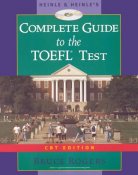
Heinle & Heinle's Complete Guide
to the TOEFL Test, CBT Edition is the latest version of the Complete
Guide to the TOEFL Test series. The book has been revised to reflect
the test's new Computer-Based Test (CBT) format. The explanations and
exercises are basically the same as in the previous editions of the
book. Changes made for the new edition include the insertion of photos
into the Preview and Review Tests in the listening section to make it
more like the real CBT. New lessons about listening and reading items
unique to the CBT have been added as well.
Rogers intends Complete Guide to the
TOEFL Test for an audience of intermediate or advanced ESL/EFL
students. He suggests that it be used by TOEFL prep classes or by
individuals for self-study. Rogers' audience does not seem to be
defined as specifically as that of some of the other TOEFL-study texts
on the market. A review of Longman Introductory Course for the TOEFL
Test (Huntly, 1997) notes that the author of this series provided score
ranges identifying the students who would benefit the most from using
it. Complete Guide to the TOEFL Test, CBT Edition would be best for the
reader who starts out with little knowledge of the CBT form of the
test. This group would include intermediate ESL students who do not
know the TOEFL CBT in any detail, as well as prospective teachers of
TOEFL prep courses. However, students whose general knowledge of the
TOEFL test is advanced are not going to find Rogers' level of detail
useful. These students don't really need to read more text describing
what the TOEFL test is like; they need practice tests.
Complete Guide to the TOEFL Test
begins with a 15-page introductory section called "Getting Started."
Basically, much of this section repeats what is in the ETS TOEFL
Bulletin. "Twelve Keys to High Scores" on the TOEFL CBT are also given,
but most of these points would be obvious to any test-taker. Among the
author's tips are general strategies like "Increase your general
knowledge of English" (p. xv) or "Use the process of elimination to
make the best guess possible [between multiple choice items]" (p.
xviii).
The four "Guides" on the listening,
structure, reading and writing sections of the TOEFL CBT form the main
body of Complete Guide to the TOEFL Test. All of the "Guides" are
organized in the same way. Each of them consists of:
an overview of that particular section of the test, with some description of what it is like
on the real TOEFL, and the basic strategies to use;
a preview test given ostensibly so that students can gain a familiarity
early on with the typical questions given in that section;
lessons broken down into various categories, with practice items on each;
review tests on the points brought up in groups of lessons;
mini-lessons at the end of each of the 4 sections.
The last part of the book consists of two complete practice tests with TOEFL-style questions.
"Guide to Listening" (pp. 2-134) is
divided into Part A ("Dialogues") and Part B ("Longer Talks"), as the
listening section of the real CBT is. Different types of dialogues are
categorized in a total of 12 lessons. The level of detail in these
lessons is noteworthy. The question types explained in Part A are those
on dialogues that involve sound confusion, homonyms, idioms, and words
with double meanings. Part A also discusses how to recognize and
approach inference questions about dialogues, and dialogue questions
that involve agreement and disagreement, as well as dialogues with
special verbs. Two review tests are inserted after lesson four and
lesson nine. Listening Part B is broken down into three lessons:
answering questions about the main idea, details and inferences, and
responding to items that involve matching and ordering information. The
"Guide to Listening" ends with mini-lessons on idiomatic expressions.
These lessons contain some 300 expressions, listed alphabetically, as
well as exercises.
The second part, "Guide to
Structure" (pp. 136-319), consists of lessons on common grammatical
points as preparation for Sentence Completion and Error Identification
questions. There are a total of 20 lessons, with 4 review tests, one
given after every 5 lessons. Among the topics covered in the lessons
are different types of clauses, as well as word forms, word choice,
verbs, prepositions, and articles. Mini-lessons provide students with
lists of prepositions, and exercises to practice them.
The third part, "Guide to Reading"
(pp. 320-455), consists of reading and vocabulary exercises. Nine
different kinds of items in the reading section are grouped in lessons,
six in all. Lesson thirty-four, for example, covers detail, negative
and scanning items. The mini-lessons for section three are on
vocabulary building, with around 500 words and their synonyms divided
into 17 lists, and practice exercises provided for each group. "Guide
to Reading" is extensive, with many different passages provided as
practice for answering different question types.
The last part, "Guide to Essay
Writing" (pp. 456-503), includes some models for analyzing prompts, and
for writing each part of the typical essay: introduction, body and
conclusion. The author outlines a process-writing approach:
pre-writing, writing, and editing. He suggests the test-taker analyze
the prompt, and then pre-write by brainstorming ideas onto paper.
Before actually beginning his/her essay, the test-taker should choose a
thesis and write a brief outline. The last step is checking one's work
after the writing is done. The basic process introduced in the first
two lessons is followed by lessons on improving the essay with signal
words and sentence variety, and checking and editing the essay.
Overall, Heinle & Heinle's
Complete Guide to the TOEFL Test, CBT Edition provides detailed
information about the TOEFL CBT. Rogers has tried to provide some
sensible tips about what it is like to take the CBT. The strength of
the book is probably the exercises for listening and structure
practice, which proceed in a step-by-step style through short lessons.
Audio:
mp3 64 KBs
CD-ROM for this edition is here:
and for iBT version 2007:
|
